These guides describe the rules implemented here. Other editions and clubs may use different variants. The worked examples are checked against this site's game logic.
Backgammon
Bring fifteen checkers around the board and bear them off before your opponent. This implementation plays a single game without a doubling cube.
Local AI practice · Private online room Players: 2
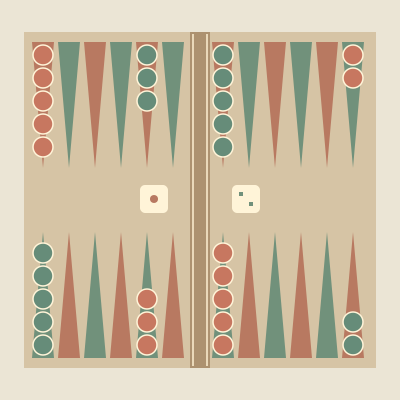
Two players travel in opposite directions. From each player’s perspective, put two checkers on point 24, five on 13, three on 8 and five on 6. The higher opening die starts using both opening dice. In these player-relative numbers, move toward lower points: 24→1→off.
On your turn
Roll two dice; doubles supply four moves. Use each die separately, including successive moves by one checker. A lone enemy is hit to the bar; two or more block entry. Re-enter bar checkers first and use the maximum number of dice possible.
Winning and ending
Bear off only when all remaining checkers are in your home six points and none is on the bar. First to remove fifteen wins.
Worked example
Synthetic finish: player 1 has fourteen off and one on point 6. With a remaining die of 6, bear that checker off to reach fifteen and win.
A common mistake
Do not skip a usable die. If only one of two different dice can be played, the higher legal die is compulsory.
Questions at the table
May an oversized die bear off?
Yes, but only from the farthest occupied home point.
Can a hit checker move normally?
It must re-enter from the bar before your other checkers move.
Further rules references
External rules provide context; the implemented variant described above takes precedence here.
Choose two, three, four or six players on the 121-hole star. Each player fills one ten-hole starting camp. Five-player games are not supported by this implementation.
On your turn
Move one piece to an adjacent empty hole in any of six directions, or jump over an adjacent piece to the empty hole immediately beyond. You may chain jumps using any colour, without revisiting a landing. Preview the full route before committing.
Winning and ending
The first player with all ten pieces in the target camp wins. Here, a piece already in its target camp may move within it but cannot leave.
Worked example
Synthetic axial coordinates: your piece at (0,0), another at (1,0), and (2,0) empty. Jump to (2,0); the jumped piece remains at (1,0).
A common mistake
Do not remove jumped pieces or treat a distant empty space as a legal jump.
Questions at the table
May I cross another camp?
Yes. Only leaving your own target camp is restricted.
Can endless blocking continue forever?
The same board and turn occurring three times, or 1,200 moves, ends this version in a draw.
Further rules references
External rules provide context; the implemented variant described above takes precedence here.
Race seven pieces off the board before your opponent. This version uses a modern reconstructed short route; it does not claim to reproduce every ancient rule.
Local AI practice · Private online room Players: 2
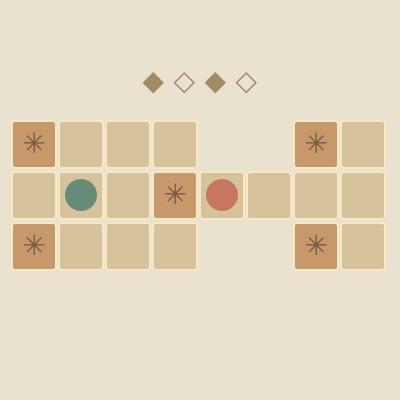
Two players begin with seven pieces in reserve. Each route contains fourteen spaces; its middle eight are shared. Four binary dice each show zero or one, giving a total from zero to four.
On your turn
Roll, then advance one piece by the total. Entering the first space costs one step. You cannot land on your own piece. Landing on an opponent in the shared section sends it to reserve, except that the central rosette is protected. Zero or no legal move means pass.
Winning and ending
Leave space 14 with an exact step off; overshooting is illegal. Bear off all seven to win.
Worked example
Synthetic position: one piece is on route space 7. Roll total 1 and move to space 8, the central rosette. You receive another roll.
A common mistake
Do not confuse a zero roll with permission to enter a new piece.
Questions at the table
Which spaces give another turn?
Rosettes at route spaces 4, 8 and 14 grant another roll.
Can I capture on the central rosette?
No. An opponent occupying space 8 blocks your landing there.
Further rules references
External rules provide context; the implemented variant described above takes precedence here.
Two to four players each start four planes in the airport. Roll a six to move one onto the runway; it enters the main track on a later roll.
On your turn
Roll and choose one movable plane. Six grants another roll, but a third consecutive six ends the turn without moving. Travel fifty track steps and six home steps. Overshooting home bounces backward. Relative coloured steps 2, 6, 10 and so on jump four; reaching 18 flies to 30 and stops.
Winning and ending
The first player with all four planes exactly at home position 56 wins.
Worked example
Synthetic position: your plane is at relative step 12 and the die is 2. It visits 13, 14, then colour-jumps to 18 and flies to 30. Your turn ends.
A common mistake
Do not apply another colour jump after the flight to 30.
Questions at the table
What happens to enemy planes at a landing?
All enemies on that shared-track landing return to their airports. Crossing the flight path does not capture.
Can stacked planes move together?
No. Friendly planes may share a space, but move individually and create no blockade.
Further rules references
External rules provide context; the implemented variant described above takes precedence here.
 little table