These guides describe the rules implemented here. Other editions and clubs may use different variants. The worked examples are checked against this site's game logic.
Dots and Boxes
Claim more boxes by drawing their fourth side. This implementation uses the extra-turn version of Dots and Boxes; the color of earlier edges does not determine who owns a box.
Local AI practice · Private online room Players: 2
Two players share a five-by-five array of dots, making sixteen small boxes and forty possible edges. The board starts empty, with both scores at zero.
On your turn
Draw one unused horizontal or vertical edge between neighboring dots. Every box completed by that edge earns one point. If you close at least one box, you must play again; otherwise the turn passes.
Winning and ending
After all forty edges are drawn, the higher score wins. Eight boxes each produces a draw. A single edge can finish two adjacent boxes.
Worked example
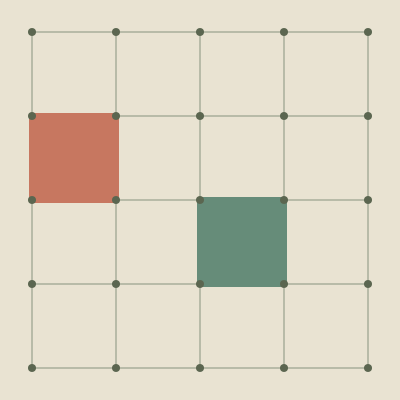
Example position: the upper-left box already has its top, bottom and left edges. Draw its right edge: you claim that box, score one point and keep the turn.
A common mistake
Do not draw a diagonal or assume that drawing a box’s third edge scores it. That often gives the next player an easy closure.
Questions at the table
Can I pass after scoring?
No. Closing a box keeps you on turn until an edge closes no box or the board fills.
Who owns a box with mixed-color edges?
The player drawing the final missing edge owns the entire box.
Further rules references
External rules provide context; the implemented variant described above takes precedence here.
Take the final object to win. This is normal-play Nim with three heaps, not the misère version in which taking the last object loses; the distinction changes endgame decisions.
Local AI practice · Private online room Players: 2
Two players start with heaps of three, four and five objects, displayed left to right. There are twelve objects in total. The starting player acts first, and turns alternate thereafter.
On your turn
Choose one nonempty heap and remove any positive number of its objects, up to that heap’s full size. You may empty a heap completely. You cannot take from two different heaps in one turn, add objects back, or pass.
Winning and ending
The player whose move leaves all three heaps empty wins immediately. Earlier objects collected do not determine the winner; there is no majority-score victory and no draw while legal play continues.
Worked example
From the initial (3,4,5), remove two objects from the first heap to leave (1,4,5), then the other player acts. In a separate example end position (0,0,2), taking both remaining objects wins at once.
A common mistake
Do not select several heaps or confuse the displayed collection totals with the victory condition.
Questions at the table
May I remove just one object?
Yes. Any amount from one through the selected heap’s current size is legal.
Does taking the last object lose?
No. In this implementation, taking the last object wins.
Mū Tōrere
Leave the opponent without a legal slide in this eight-point-ring Mū Tōrere table. No pieces are captured.
Local AI practice · Private online room Players: 2
Eight outer points surround a single centre. Number the ring 1–8 consecutively: one side occupies 1–4, the other 5–8, with the centre empty. Each side always has four pieces.
On your turn
Move one piece into an empty connected point. Outer pieces may move to either adjacent ring point. A centre piece may move outward. An outer piece may enter the centre only when at least one of its two ring neighbours belongs to the opponent.
Winning and ending
A player who cannot move loses. Threefold repetition or 120 actions without progress draws; controlling the centre alone is not a win.
Worked example
Opening example: move your piece from outer point 1 into the centre. It is legal because neighbouring point 8 holds an enemy. Point 1 becomes empty and the opponent moves next. Moving point 2 into the centre instead is illegal: both its neighbours are friendly.
A common mistake
Do not assume every spoke gives unconditional entry to the centre; check the two ring neighbours first.
Questions at the table
Can I jump across the centre?
No. A move stops at one adjacent empty point.
Can I remove an opposing piece?
No. The only way to win is to deny legal movement.
Further rules references
External rules provide context; the implemented variant described above takes precedence here.
 little table