These guides describe the rules implemented here. Other editions and clubs may use different variants. The worked examples are checked against this site's game logic.
Alquerque
Capture or immobilize the opposing army in this all-direction, compulsory-capture Alquerque variant.
Local AI practice · Private online room Players: 2
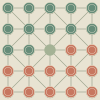
The 5×5 network has twelve pieces per side and an empty centre. Each army fills two rows and two points of the middle row.
On your turn
Move one point along a drawn line only when no capture is available. Otherwise jump an adjacent enemy into the empty point beyond. Continue with that same piece whenever another jump exists; direction may change.
Winning and ending
Taking every enemy or leaving the opponent without a legal move wins. Threefold repetition or 80 capture-free moves draws.
Worked example
Example position, with (row, column) counted from the upper left: you occupy (1,1); enemies occupy (1,2), (1,4), (5,5); other points are empty. Jump to (1,3), removing (1,2), then you must jump to (1,5), removing (1,4). Only then does the turn pass.
A common mistake
A diagonal-looking destination is insufficient: both parts of a jump must follow the board’s connections.
Questions at the table
Can I move backward?
Yes. This table permits ordinary moves and captures in every connected direction.
Must I choose the longest capture route?
No. Choose any legal capture, but complete all available continuation jumps on that chosen route.
Further rules references
External rules provide context; the implemented variant described above takes precedence here.
Alternating black and white stones fill the board. Black removes a black corner or central stone; White removes an orthogonally adjacent white stone. Black then starts jumping.
On your turn
Every playing move jumps orthogonally over one enemy into an empty square, removing that enemy. A turn may continue with the same stone only in the same direction. Continuing is optional; end the turn when you prefer.
Winning and ending
The player with no legal capture loses. Captured stones do not return, so preserving future landing squares matters more than simply taking the most stones now.
Worked example
Example position, (row, column) from the upper left: your stone at (1,1), enemies at (1,2), (1,4), (2,3), (8,8), all else empty. Jump to (1,3), taking (1,2). You may continue to (1,5) or finish, but cannot turn downward to (3,3).
A common mistake
Do not plan a quiet one-square escape: ordinary steps do not exist after the opening.
Questions at the table
Can a capture chain turn a corner?
No. Every continuation keeps the first jump’s direction.
Which black openings are offered here?
The two black corners and two black central squares; White must remove a neighbouring stone.
Further rules references
External rules provide context; the implemented variant described above takes precedence here.
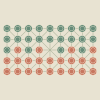
Each side begins with twenty-two pieces. Two full rows face two full rows; the middle row alternates around its empty centre.
On your turn
Move to a neighbouring empty point along a drawn line. If any capture exists, capture: approach removes consecutive enemies beyond the destination; withdrawal removes consecutive enemies behind the origin. Select one mode. Further captures with the same piece are optional; never revisit a point or repeat the immediately previous direction.
Winning and ending
Eliminate all enemies or leave them without a legal move. Three repetitions or 120 actions without progress draws.
Worked example
Example position, coordinates (row, column) from the upper left: your piece at (3,5), enemies at (3,4), (3,7), (3,8), all else empty. Move to (3,6) using approach: remove (3,7) and (3,8), leaving (3,4). Withdrawal instead would remove only (3,4).
A common mistake
Do not take enemies on both sides of the same move; choose approach or withdrawal.
Questions at the table
Must I continue after capturing?
No. You may finish even when another legal capture remains.
Can I take disconnected enemies farther along a line?
No. An empty point or friendly piece stops the captured run.
Further rules references
External rules provide context; the implemented variant described above takes precedence here.
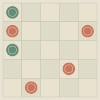
On a 5×5 board, each side places twelve stones, two consecutively per turn. The centre must remain empty during placement. The opening player begins movement after all stones are placed.
On your turn
Slide one stone one square horizontally or vertically. An adjacent enemy trapped between the moved stone and another friendly stone is removed; multiple directions may capture. A stone on the centre is immune. There is no capture continuation.
Winning and ending
Reduce the opponent below two stones to win. A blocked player passes; if both are blocked, more stones wins. Equal counts, three repetitions or 120 actions without progress draws.
Worked example
Example position after placement, (row, column) from the upper left: your stones (2,1), (2,4); enemies (2,3), (5,4), (5,5); others empty. Move (2,1) to (2,2). The enemy at (2,3) is sandwiched and removed, then the opponent moves.
A common mistake
Do not expect the central stone to be captured by an otherwise valid sandwich.
Questions at the table
Can I place on the centre?
No during setup; it becomes available for movement afterward.
May I pass with a legal move available?
No. Passing is offered only when you cannot slide a stone.
Further rules references
External rules provide context; the implemented variant described above takes precedence here.
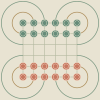
Each player has twelve pieces occupying their nearest two rows. Pieces sit on intersections, not inside the drawn squares.
On your turn
An ordinary move is one step to any adjacent empty point, including diagonals. A capture follows an orthogonal track through empty points and at least one corner loop, landing on the first enemy encountered. A friendly piece blocks the route, and no piece may be jumped.
Winning and ending
Remove every enemy or leave the opponent without a legal action. Threefold repetition or 120 actions without capture draws; a material lead alone does not automatically win.
Worked example
Example position, (row, column) from the upper left: your piece (2,2), enemies (1,2) and (6,6), all else empty. Travel left through (2,1), around the corner loop and into (1,2), replacing that enemy. A direct ordinary step onto it would be illegal.
A common mistake
Seeing an enemy in the same column does not permit capture without first traversing a loop.
Questions at the table
Can ordinary moves use a loop?
No. Loops are part of capturing routes, not ordinary steps.
Can I pass over an enemy to capture farther away?
No. The first occupied point stops the route.
Further rules references
External rules provide context; the implemented variant described above takes precedence here.
 little table