 little table
Xiangqi
Trap the opposing general so it has no legal response. This Xiangqi implementation treats both checkmate and stalemate as losses and uses limited repetition adjudication rather than a complete long-chase tournament referee.
Local AI practice · Private online room
Players: 2
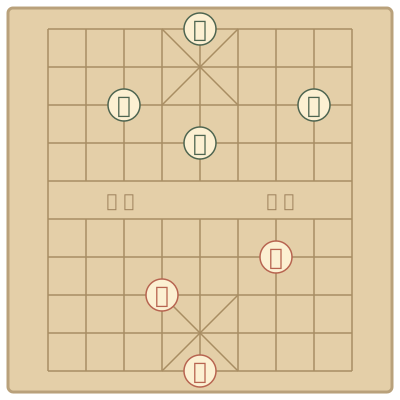
Set up the table
Red starts on a nine-file, ten-rank intersection board. Each side has a general, two advisors, elephants, horses, chariots and cannons, plus five soldiers. Palaces and the river constrain movement.
On your turn
Chariots slide orthogonally. Cannons slide along clear orthogonal paths without capturing but jump exactly one intervening piece to capture. Horses move in an L unless their first orthogonal step is blocked. Elephants move two diagonally with an empty midpoint and cannot cross the river. Advisors step one point diagonally and generals one point orthogonally inside the palace. Soldiers step forward, gaining sideways steps after crossing; never backward. No move may expose your general to attack. Ordinary captures replace the enemy piece on its intersection; you cannot land on a friendly piece.
Winning and ending
No legal move loses. Three repetitions draw unless one side is solely responsible for perpetual check; that side loses. One hundred twenty consecutive half-moves without a capture also draw.
Worked example
From the starting position, Red’s cannon moves b2–b9, capturing the black horse. The cannon at b7 is the single intervening screen and stays in place. Files a–i run left to right from Red; ranks 0–9 run toward Black.
A common mistake
Generals may not face each other along an unobstructed file; moving a blocking piece may therefore be illegal.
Questions at the table
Can a cannon capture without a screen?
No. A capture needs exactly one intervening piece of either color.
Does a soldier promote at the far edge?
No. It keeps its forward/sideways movement limits.