These guides describe the rules implemented here. Other editions and clubs may use different variants. The worked examples are checked against this site's game logic.
Fox and Geese
The geese try to trap the fox; the fox tries to remove ten geese in this thirteen-goose variant.
Local AI practice · Private online room Players: 2
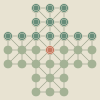
A 33-point cross holds thirteen geese across its upper three rows and one fox at the centre. The fox starts; roles alternate on rematches.
On your turn
Follow drawn lines. The fox steps in any direction or jumps one adjacent goose into an empty point. Further jumps are optional. Geese step sideways or toward the lower edge, including connected forward diagonals; they never capture.
Winning and ending
Geese win when the fox cannot move. The fox wins after ten captures or when the geese cannot move. Three repetitions or 120 capture-free moves draws.
Worked example
Example position on the surrounding 7×7 grid, counted from the upper left: fox (4,1), geese (4,2), (4,4), (5,7). All other points are empty. Jump to (4,3), taking one goose. A second jump to (4,5) is available, but ending the turn is legal.
A common mistake
Avoid leaving an empty landing point behind an exposed goose: adjacency alone does not protect it.
Questions at the table
Must the fox capture?
No. It may choose a legal ordinary step even when a jump exists.
Can geese retreat to repair their line?
No. Backward moves are unavailable in this table.
Further rules references
External rules provide context; the implemented variant described above takes precedence here.
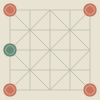
Tigers begin on the four corners of a 5×5 connected-point board. Goats begin off board and take the first turn.
On your turn
Until all twenty goats have been placed, each goat turn adds one to any empty point. Then goats move one step along a line. Tigers may step along a line or jump one adjacent goat into the empty point beyond, removing it. Captures are optional and never chained.
Winning and ending
Five captured goats win for tigers; leaving all four tigers without a legal move wins for goats. Repeated positions three times or 120 actions without progress draws.
Worked example
Opening example, (row, column) from the upper left: place a goat at (1,2). The tiger at (1,1) can jump to (1,3), removing that goat and scoring its first capture. Nineteen goats still await placement; the goat side places again.
A common mistake
A newly placed goat does not become movable while any goat remains in reserve.
Questions at the table
Can a goat capture a tiger?
No. Goats win by denying both stepping and jumping destinations.
Must a tiger make an available capture?
No. A legal single-step move remains an option.
Further rules references
External rules provide context; the implemented variant described above takes precedence here.
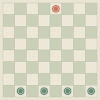
Use one colour of an 8×8 board. Counting (row, column) from the upper left, the fox starts at (1,5), hounds at (8,2), (8,4), (8,6), (8,8). The fox moves first.
On your turn
Each turn moves one piece one diagonal square into emptiness. The fox may move toward either end. Hounds move only toward decreasing row numbers, so their formation cannot retreat. There are no jumps or captures.
Winning and ending
The fox wins by reaching row 8 or moving beyond every hound toward that row. Hounds win by blocking the fox. A side without a legal move loses; three repetitions or 120 quiet actions draws.
Worked example
Opening example: the fox moves (1,5) to (2,4). A hound may answer (8,2) to (7,1). All five pieces remain, and it is the fox’s turn again.
A common mistake
Do not let a hound advance so far alone that the fox can pass behind the whole line.
Questions at the table
Can hounds step sideways or backward?
No. Their only choices are the two forward diagonals, when empty.
Can the fox jump over a blocking hound?
No. Every legal move is one empty diagonal step.
Further rules references
External rules provide context; the implemented variant described above takes precedence here.
 little table