These guides describe the rules implemented here. Other editions and clubs may use different variants. The worked examples are checked against this site's game logic.
Burr Puzzles
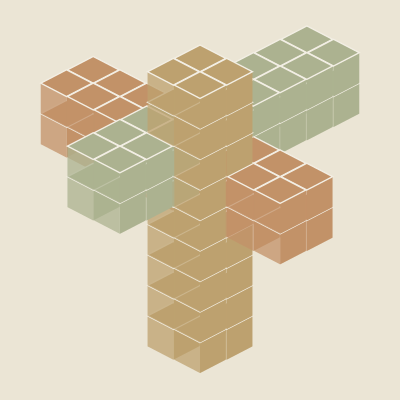
Separate interlocking wooden pieces by finding an unobstructed sequence of slides. These are three original introductory puzzles, not replicas of a named commercial burr.
Choose the three-, four- or six-piece solo challenge. Disassembly begins with every piece at offset zero. Assembly practice, available before moving, starts all pieces at offset +10.
On your turn
Select a piece and slide along its own fixed axis. A step moves one unit; extraction travels only through clear intermediate positions until blocked or fully out. Orbiting the camera changes your view, not the wooden geometry.
Winning and ending
For disassembly, every piece must reach offset +10 or −10. For assembly, return every piece to zero.
Worked example
In the first three-piece puzzle, extract piece 1 in the positive direction: offsets change from [0,0,0] to [10,0,0]. One piece is out; undo restores the starting offsets.
A common mistake
A clear destination is insufficient if another piece blocks the route. Pieces cannot rotate or pass through one another.
Questions at the table
Can I undo a slide?
Yes. Undo restores the preceding set of piece offsets.
Do I need other players?
No. These challenges are solo; there are no opponent turns or cooperative room seats.
Further rules references
External rules provide context; the implemented variant described above takes precedence here.
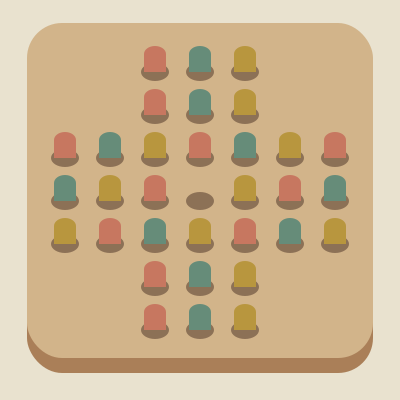
Remove pegs by jumping until exactly one remains. This is a solo puzzle on the traditional 33-hole cross, not a game of capturing an opponent’s pieces.
The full board starts with 32 pegs and the centre empty. Three shorter starts are positions reached after eight, sixteen or twenty-four moves along one verified solution.
On your turn
Choose an occupied hole, jump horizontally or vertically over one adjacent peg into the empty hole immediately beyond, and remove the jumped peg. Each jump reduces the count by one. Preview the landing, then confirm; rotating the view does not permit diagonal jumps.
Winning and ending
Any single remaining peg solves this implementation. A blocked board with several pegs is not a success, but undo remains available.
Worked example
From the full start, count columns left to right and rows top to bottom, starting at 1. Jump (4,2) over (4,3) into the empty centre (4,4). Thirty-one pegs remain.
A common mistake
You need both an adjacent peg and an empty landing. Merely moving into a neighbouring empty hole is illegal.
Questions at the table
Must the last peg be central?
No. The implemented goal checks for one peg anywhere.
What if I leave the hint route?
Hints may suggest undoing; other legal solutions are still accepted.
Further rules references
External rules provide context; the implemented variant described above takes precedence here.
 little table