These guides describe the rules implemented here. Other editions and clubs may use different variants. The worked examples are checked against this site's game logic.
Nine Men’s Morris
In this Nine Men’s Morris variant, form mills to remove opposing pieces, then leave the opponent with fewer than three pieces or no legal move once their reserve is empty.
Local AI practice · Private online room Players: 2
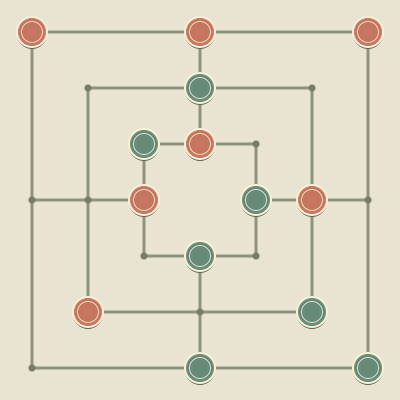
Each player has nine pieces in reserve. The empty board has twenty-four points on three nested squares, connected at the side midpoints.
On your turn
Place one reserve piece on an empty point. After deployment, slide along a drawn connection to an adjacent empty point. With exactly three pieces remaining, you may fly to any empty point. Completing a marked three-point mill requires removing one opposing piece before the turn ends.
Winning and ending
An opponent without reserve loses with fewer than three pieces or no move. Threefold repetition or one hundred consecutive non-capturing movement actions draws.
Worked example
Example position: your pieces occupy the outer square’s upper-left corner and top midpoint. Place at its upper-right corner, then remove the opponent’s lone exposed piece at the outer lower-right corner. Only then does the turn change.
A common mistake
A piece in a mill is protected while any opposing piece lies outside all mills.
Questions at the table
Does a double mill remove two pieces?
No. One action that forms two mills still grants just one capture.
Can I fly while I still have reserve pieces?
No. Deploy your reserve first; flying applies when you have exactly three pieces on the board.
Three Men’s Morris
Arrange your three pieces into a straight line. This Three Men’s Morris variant uses a three-by-three board with diagonal connections through the center and continues with sliding after the six pieces are placed.
Local AI practice · Private online room Players: 2
Each player has three reserve pieces, and all nine points begin empty. Players alternate placements, one piece at a time. A winning line can already end the game during this deployment stage.
On your turn
Once both reserves are empty, move one of your pieces along a connection to an adjacent empty point. Orthogonal neighbors connect; a diagonal step is allowed only when one endpoint is the center. No piece is captured, and there is no flying move.
Winning and ending
Any full row, column or corner-to-corner diagonal wins. An opponent without a legal move loses. Three repetitions or 120 consecutive sliding actions without a placement produce a draw.
Worked example
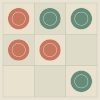
Example position after deployment: you occupy top-left, top-middle and middle-right; the opponent occupies middle-left, bottom-left and bottom-middle. Slide middle-right to top-right to complete the top row and win.
A common mistake
Do not move an outer point diagonally to another outer point just because the squares touch at a corner.
Questions at the table
May I move while reserve pieces remain?
No. Finish the alternating placement phase before sliding.
Does a completed line remove an enemy piece?
No. Unlike Nine Men’s Morris, a line wins immediately rather than starting a capture.
Further rules references
External rules provide context; the implemented variant described above takes precedence here.
Each player alternately places twelve stones. During placement, making a row of three or more of your own stones is forbidden. Movement begins after both reserves are exhausted.
On your turn
Move one stone one square horizontally or vertically into emptiness. A new row of exactly three through the moved stone earns removal of one enemy. Select that enemy before the turn passes. Four or more in a row is illegal; diagonals do not count.
Winning and ending
Reduce the opponent below three stones or leave them without a legal move. Three repetitions or 120 actions without progress draws.
Worked example
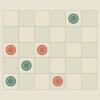
Example position after placement, (row, column) from the upper left: yours (1,1), (1,2), (2,3); enemies (4,1), (4,3), (4,5), others empty. Move (2,3) to (1,3), then remove (4,1). The opponent has two stones, so you win.
A common mistake
Do not build three during setup: this table rejects the placement rather than awarding a capture.
Questions at the table
If I create two threes, do I capture twice?
No. A move grants only one enemy removal.
Are enemies in their own three protected?
No. This table lets you select any enemy stone in the capture phase.
Further rules references
External rules provide context; the implemented variant described above takes precedence here.
Be the first player to occupy a full line of three squares. This is the standard placement-only three-by-three Tic-Tac-Toe game; there is no movement stage after the board fills.
Local AI practice · Private online room Players: 2
Two players begin with an empty nine-square board. The starting player takes the first turn, then players alternate. A square can hold only one player’s mark and cannot be overwritten.
On your turn
Choose any empty square and place one mark. Check your own immediate winning threats and the opponent’s before committing. A mark stays on its square for the remainder of the game; there are no captures or extra turns.
Winning and ending
Three of your marks in one row, column or either long diagonal wins immediately. If the ninth square is filled with no winner, the result is a draw. A nearly complete line does not score anything by itself.
Worked example
Starting from empty, the first player chooses top-left, the second center, the first top-middle, the second bottom-left, and the first top-right. The first player completes the top row and wins.
A common mistake
Do not keep placing marks after a winning line appears; the round has already ended.
Questions at the table
Does a diagonal count?
Yes. Either corner-to-corner diagonal is a winning line when all three squares are yours.
Can I relocate a mark when there is no empty square?
 little table