These guides describe the rules implemented here. Other editions and clubs may use different variants. The worked examples are checked against this site's game logic.
Oware
Collect a majority of the 48 seeds in this Abapa-style Oware table.
Local AI practice · Private online room Players: 2
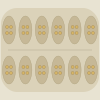
Each player owns six pits, initially holding four seeds each. Number your pits 1–6 in sowing order; your sixth is followed by the opponent’s first.
On your turn
Empty one own pit and sow counterclockwise, one seed per pit, skipping the origin on a full circuit. A final enemy pit containing two or three is harvested, then preceding enemy pits containing two or three.
Winning and ending
More than 24 wins; 24 each draws. When feeding becomes impossible, threefold repetition occurs or 160 harvest-free turns pass, remaining seeds are collected by side.
Worked example
Opening example: sow your first pit’s four seeds. Your pits 1–6 become 0, 5, 5, 5, 5, 4. No enemy pit receives the final seed, so neither player scores; the opponent moves next.
A common mistake
Do not assume that every possible harvest is allowed: emptying the opponent’s entire side cancels the whole harvest.
Questions at the table
Must I feed an empty opposing side?
Yes, whenever a sowing move can deliver seeds there. Other moves are unavailable.
Does a full circuit refill the starting pit?
No. Skip it every time the sowing returns there.
Further rules references
External rules provide context; the implemented variant described above takes precedence here.
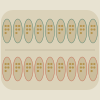
Every pit starts with nine seeds. Number each side’s pits 1–9 in sowing order; your ninth is followed by the opponent’s first.
On your turn
Choose a nonempty own pit. With multiple seeds, leave one and sow the others counterclockwise; a lone seed moves to the next pit. An even final enemy-pit total is harvested. A final total of three can establish your single permanent tuzdyk, whose incoming seeds score for you.
Winning and ending
Reach 82 to win. When the next player cannot sow, remaining seeds are collected by side; equal totals draw.
Worked example
Opening example: sow your ninth pit’s nine seeds. Leave one there, distribute eight into opposing pits 1–8, then harvest the ten seeds now in opposing pit 8. Your score is ten and that pit is empty.
A common mistake
Do not use Oware’s empty-origin rule: with multiple seeds, this game starts by leaving one behind.
Questions at the table
Where may I claim a tuzdyk?
Not in the opponent’s ninth pit, nor at the same numbered pit as their tuzdyk. You may claim only one.
Can a tuzdyk itself be sown?
No. Seeds arriving there are collected by its owner instead.
Further rules references
External rules provide context; the implemented variant described above takes precedence here.
 little table