 little table
Gomoku
Make an uninterrupted line of at least five stones of your color. This is freestyle Gomoku: both colors can win with a longer line, and Black has no forbidden double-three, double-four or overline moves.
Local AI practice · Private online room
Players: 2
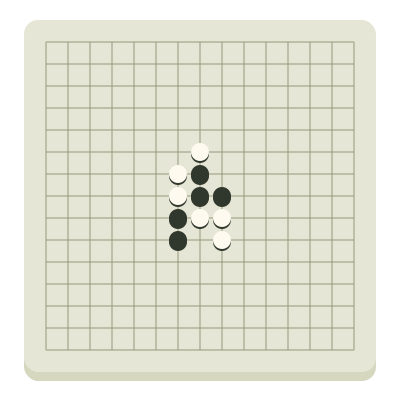
Set up the table
Two players start on an empty fifteen-by-fifteen intersection board, with 225 playable points. Black moves first. There is no special opening placement sequence or color-swap stage in this engine.
On your turn
Place exactly one stone on any empty intersection, then pass the turn. Existing stones stay where they are; there are no captures, slides or jumps. Lines count horizontally, vertically and along either diagonal.
Winning and ending
The first placement completing five or more consecutive stones wins immediately. If all 225 intersections fill without such a line, the game is a draw. A gap breaks a line until filled.
Worked example
Example position, counting from the top-left: Black occupies row 8, columns 4, 5, 6, 7 and 9. Playing column 8 connects six consecutive black stones and wins under this freestyle rule.
A common mistake
Do not reject a six-stone line as an overline foul; that restriction belongs to different rule variants.
Questions at the table
Must the winning line have open ends?
No. The engine checks consecutive stones, not whether either end is open.
Can I move an already placed stone?
No. Every turn adds a new stone to an empty point.