These guides describe the rules implemented here. Other editions and clubs may use different variants. The worked examples are checked against this site's game logic.
English Draughts
This is English-style draughts on an eight-by-eight board. Capture every opposing piece or leave the opponent without a legal move; men and kings have different movement limits.
Local AI practice · Private online room Players: 2
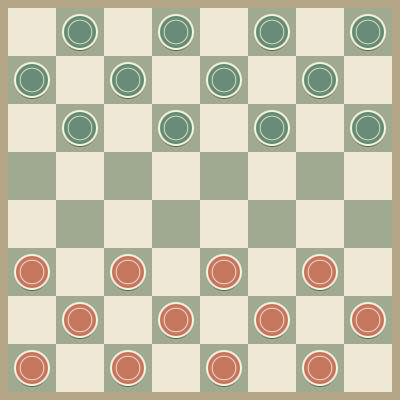
Each player starts with twelve men on dark squares in the nearest three rows. The bottom player moves toward the top; the top player moves toward the bottom.
On your turn
A man moves one diagonal square forward. Captures jump forward over an adjacent enemy onto the empty square beyond. Capturing is compulsory, and the same piece must continue an available jump sequence. Kings step and jump diagonally both ways but do not fly. Reaching the far row crowns a man and ends its turn.
Winning and ending
No pieces or no legal move means defeat. Threefold repetition or eighty consecutive non-capturing king actions draws.
Worked example
Example position, counting rows and columns from the top-left: a bottom-side man at (6,1) jumps over (5,2) to (4,3), then must jump over (3,4) to (2,5). Both enemies are removed before the turn passes.
A common mistake
Do not use backward man captures or long king slides from other draughts variants.
Questions at the table
Must I choose the longest capture?
No. Any legal capture branch is allowed, but that branch must be completed.
Can a newly crowned king continue capturing?
No. Promotion ends the turn in this version.
Russian Draughts
Capture all opposing pieces or stop the opponent from moving. This Russian draughts implementation combines backward man captures, flying kings and immediate promotion during a capture chain.
Local AI practice · Private online room Players: 2
Each side begins with twelve men on the dark squares of its nearest three rows on an eight-by-eight board. Bottom-side men advance toward the top; their opponents advance downward.
On your turn
A quiet man move is one diagonal square forward, but captures jump an adjacent enemy in either diagonal direction. Capture is compulsory; choose any available branch and continue with that piece while it can capture. Kings travel along open diagonals and may land beyond one jumped enemy. A man reaching the far row during a jump becomes a king immediately and continues with king powers.
Winning and ending
The opponent loses without a legal move. This implementation uses threefold repetition or 120 consecutive non-capturing king actions for draws; it does not reproduce every federation endgame-count rule.
Worked example
Example position, counted from top-left: your man at (3,2) jumps the enemy on (2,3) to (1,4), becomes king, then flies over an enemy on (3,6) to (4,7). The turn ends after both captures.
A common mistake
Do not end the turn just because a capture has crowned your piece; further king captures remain compulsory.
Questions at the table
Must I take the largest number of pieces?
No. Russian rules here permit shorter branches, unlike the International and Turkish implementations.
Can a king cross a square captured earlier in the same chain?
No. Captured squares remain blocked until that chain finishes.
International Draughts
Defeat the opponent by capturing or immobilizing every piece. This International draughts implementation uses the ten-by-ten board, backward man captures, flying kings and compulsory maximum captures.
Local AI practice · Private online room Players: 2
Each player has twenty men occupying the dark squares in their nearest four rows; the middle two rows are empty. Bottom-side men advance upward and top-side men downward.
On your turn
A man moves one diagonal square forward without capturing, but can jump an adjacent enemy forward or backward. Kings slide on open diagonals and land beyond a jumped enemy. When captures exist, choose a route taking the greatest number of pieces, then continue it with the same piece. Men are crowned only after the complete chain if they finish on the far row.
Winning and ending
No legal move loses. Threefold repetition or 120 consecutive non-capturing king actions draws here; this is a simplified draw policy rather than every official endgame-count provision.
Worked example
Example position, coordinates from top-left: your men occupy (6,1) and (6,5); enemies are at (5,2), (3,4), (5,6). You must take (6,1)→(4,3)→(2,5), removing two enemies. The one-capture alternative from (6,5) is excluded.
A common mistake
Do not promote midway through a chain and then use flying-king powers; Russian draughts handles this differently.
Questions at the table
What if two routes capture the same maximum number?
Either route is legal; captured kings do not get extra numerical weight.
May a king cross an already captured square during the chain?
No. Those squares remain blocked until the chain ends.
Further rules references
External rules provide context; the implemented variant described above takes precedence here.
Remove or immobilize the opposing army in this orthogonal Turkish draughts variant. Unlike diagonal draughts, every square is used, and men can move sideways as well as forward.
Local AI practice · Private online room Players: 2
Each player starts with sixteen men filling their second and third rows on an eight-by-eight board. The back rows and the two middle rows are empty. Bottom-side men advance upward.
On your turn
Men step one square forward or sideways and capture by jumping an adjacent enemy onto the empty square beyond in those directions. Kings slide and capture along rows or columns. Captures are compulsory, and only routes taking the maximum number of pieces are allowed. Continue with the same piece; do not reverse direction by 180 degrees within a chain. Promotion occurs after the chain ends.
Winning and ending
No legal move loses. This implementation additionally resolves one-piece-each endings immediately: king beats man; equal types draw. Threefold repetition or 120 quiet king actions draws.
Worked example
Example position, coordinates counted from top-left: your men are at (6,1) and (6,5); enemies block (5,1), (3,1) and (5,5). Choose (6,1)→(4,1)→(2,1), capturing two. The single capture from (6,5) is not legal.
A common mistake
Do not jump backward with a man or choose a shorter capture for positional advantage.
Questions at the table
When does a man become a king?
At the end of its move or capture chain if it finishes on the far row.
Can kings turn during a capture chain?
Yes, by ninety degrees; immediate reversal along the previous direction is prohibited.
Further rules references
External rules provide context; the implemented variant described above takes precedence here.
 little table